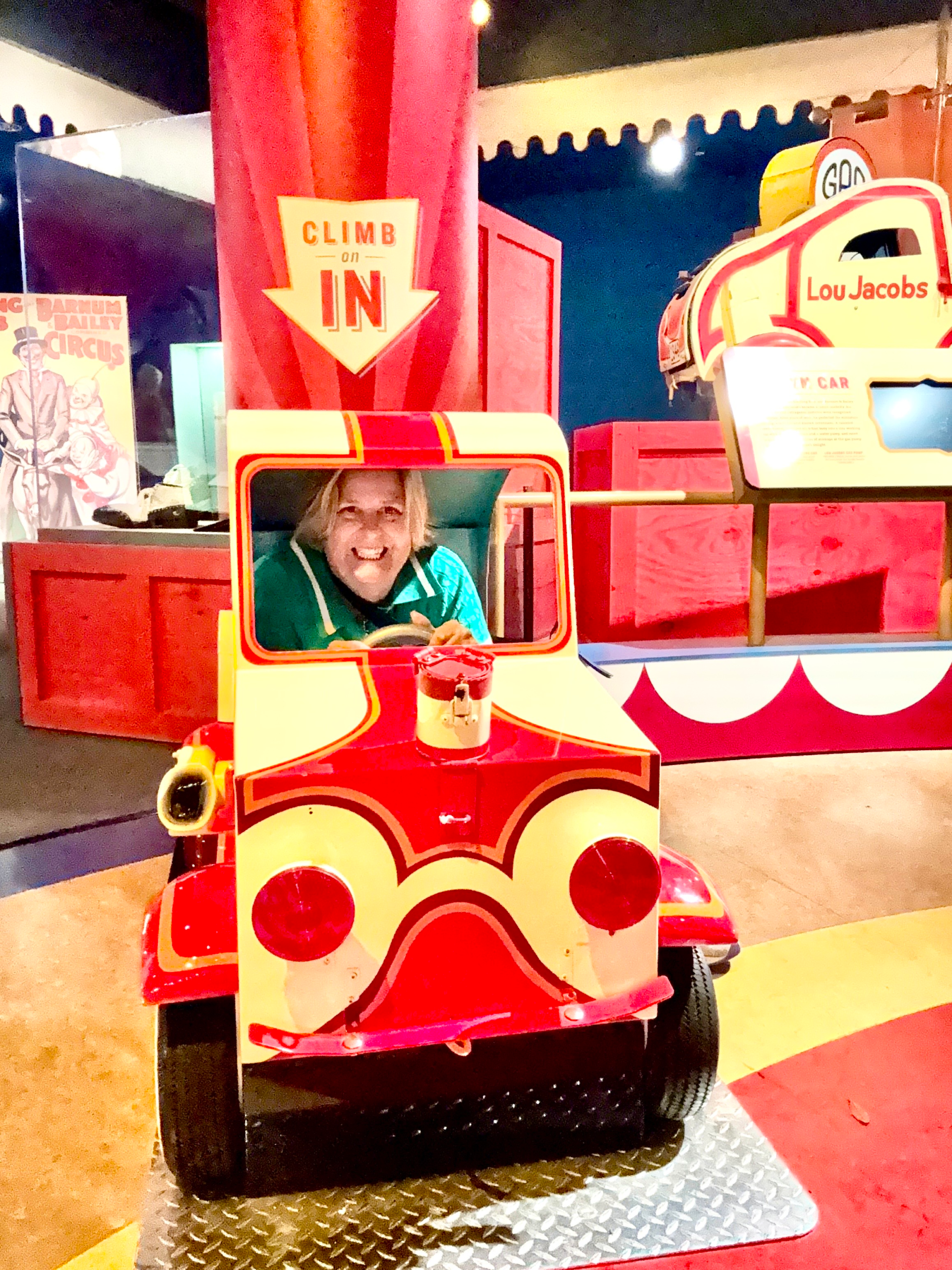
The morning began beneath the bright banners and painted wagons of the circus galleries at the The John and Mable Ringling Museum of Art. Posters of acrobats, lion tamers, and daring aerialists lined the walls, and told the story of how the American circus once crisscrossed the country by rail. Costumes sparkled under soft lights, and the air seemed almost filled with the echoes of calliope music. Here, you, too can run away to the circus. Become a clown, walk the high wire, tame a fierce tiger. It’s all available where the legacy of John Ringling comes alive—the showman who helped transform the traveling circus into one of the most spectacular forms of entertainment in early twentieth-century America.
After playing, I walked around the corner, and the world shrank to an astonishing scale in the miniature circus created by Howard Tibbals. Beneath glass cases stretched a tiny but incredibly detailed three-ring circus, complete with trains, performers, tents, and thousands of hand-crafted figures- a frozen moment from circus day in the 1910s and 1920s, a reminder of the immense logistical machine that once rolled into towns across the country.
Leaving the circus behind, a path lined with palms led towards the waterfront and the Venetian-style mansion known as Ca’ d’Zan. The name means “House of John” in Venetian dialect, and the palace reflects the tastes of both John Ringlingand his wife Mable Ringling. Built in the mid-1920s, the home rises like a Mediterranean dream along the edge of Sarasota Bay, with colorful tiles, arched windows, and a terrace overlooking the water.
The mansion was constructed during the exuberant years of the Roaring Twenties, when wealth from industries like entertainment and real estate fueled grand architectural projects across the United States. Sarasota was still a quiet coastal town, but John Ringling believed in its future. The calm waters of Sarasota Bay, warm winters, and scenic beauty reminded the couple of Venice, Italy, making it the perfect location for their winter home and cultural estate.
Outside the mansion, gardens stretch toward the shoreline. Mable’s rose garden adds color and fragrance, while marble statues appear throughout the grounds—classical figures that give the estate the feeling of an outdoor gallery. The sculptures frame walkways, reflect in fountains, and guide visitors slowly back toward the cultural heart of the property.
That heart is the Museum of Art itself. John Ringling, an avid traveler and collector, built the museum to house the European paintings and sculptures he acquired during frequent trips abroad. The pink Renaissance-style building surrounds a grand courtyard filled with replicas of classical statues, echoing the design of Italian palaces. Inside are works by Old Masters that Ringling purchased through dealers and auctions across Europe, determined to bring world-class art to Florida.
By the time the walk ended, the estate revealed itself as more than a museum. It showed as a reflection of a circus king’s ambition—an entire cultural landscape where spectacle, art, and the elegance of the 1920s still linger along the shores of Sarasota Bay.
Tips & Advice:
Plant to begin your visit between 10-11 AM right after opening, when it’s the least crowded
Tuesdays tend to be the least crowded days
Teacher receive a huge discount- my ticket was $25 as opposed to $40+
Students are $5
Wear comfortable shoes
Watch the video tour here: